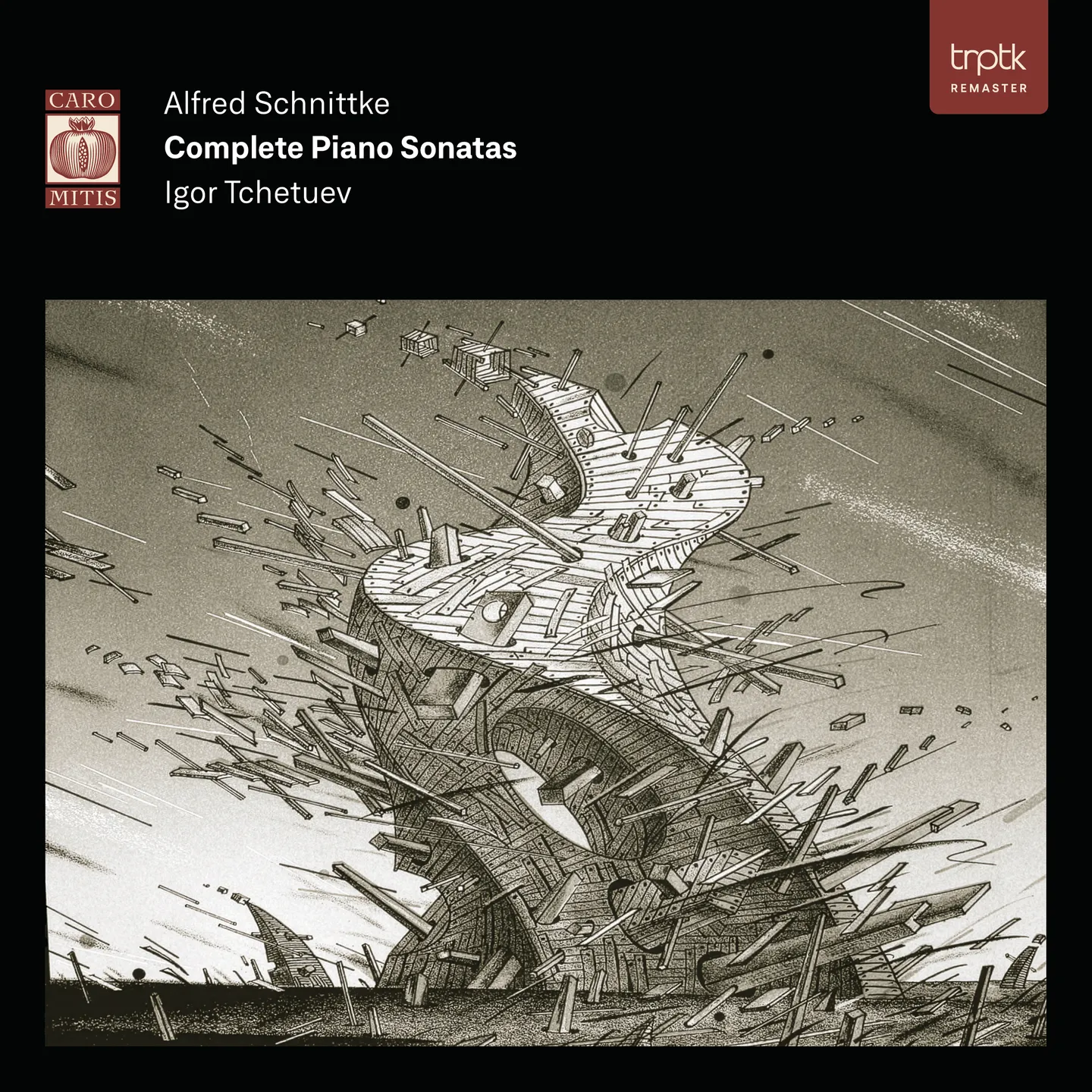
Schnittke's piano sonatas are the works almost nobody recommends. Ask a Schnittke devotee where to start and you'll hear about the symphonies, the concerti grossi, the chamber music — rarely the sonatas. There are only three, all written late: 1988, 1990, and 1992. They are rarely programmed, and the recordings are few.
This is a shame, and also somehow fitting. Schnittke wrote about wanting to hide things in his music — "the more everything is 'hidden' in a piece of music, the more it gains in depth and infinity." The sonatas take him at his word. Their surfaces are austere, often bare; the slow movements are stripped down to single-line recitatives and chorales that barely sound like piano music at all. There is nothing here to seduce a casual listener.
The three sonatas function almost as one work, said three times. Each returns to the same kind of slow movement — Schnittke marks them all Lento — and each ends in some form of collapse. The First, dedicated to Vladimir Feltsman, builds its slow theme from a musical monogram of both men's names. The Second, dedicated to Schnittke's wife Irina, puts its enigmatic chorale at the centre of the form: a sarabande rhythm that could be heavenly or infernal, and which gets the last word after the finale has spent itself. The Third was written when Schnittke was already gravely ill. It begins not with a theme but with a chromatic scale rising from the bottom of the keyboard — raw material, not yet music — and ends with a passage that loses itself in its final chord.
The earlier Improvisation and Fugue (1965) sits at the other end of Schnittke's life. He wrote it on commission for the Tchaikovsky Competition; for reasons that are no longer clear, nobody played it there. It's a virtuoso piece that sounds, on first hearing, like controlled chaos — chords from Beethoven's Waldstein surfacing alongside Prokofiev intonations, a bass phrase muttering and disappearing. Underneath it all is a strict twelve-tone series. Schnittke himself was disarmingly casual about the fugue, calling it "more of a motor work, with the contours of a fugue, rather than a fugue proper." The technique is meant to be felt, not heard. That was always the point.
These are not easy works, and they will not meet a listener halfway. But they reward the time. As Feltsman once said of Schnittke's music: it leads you back to yourself.