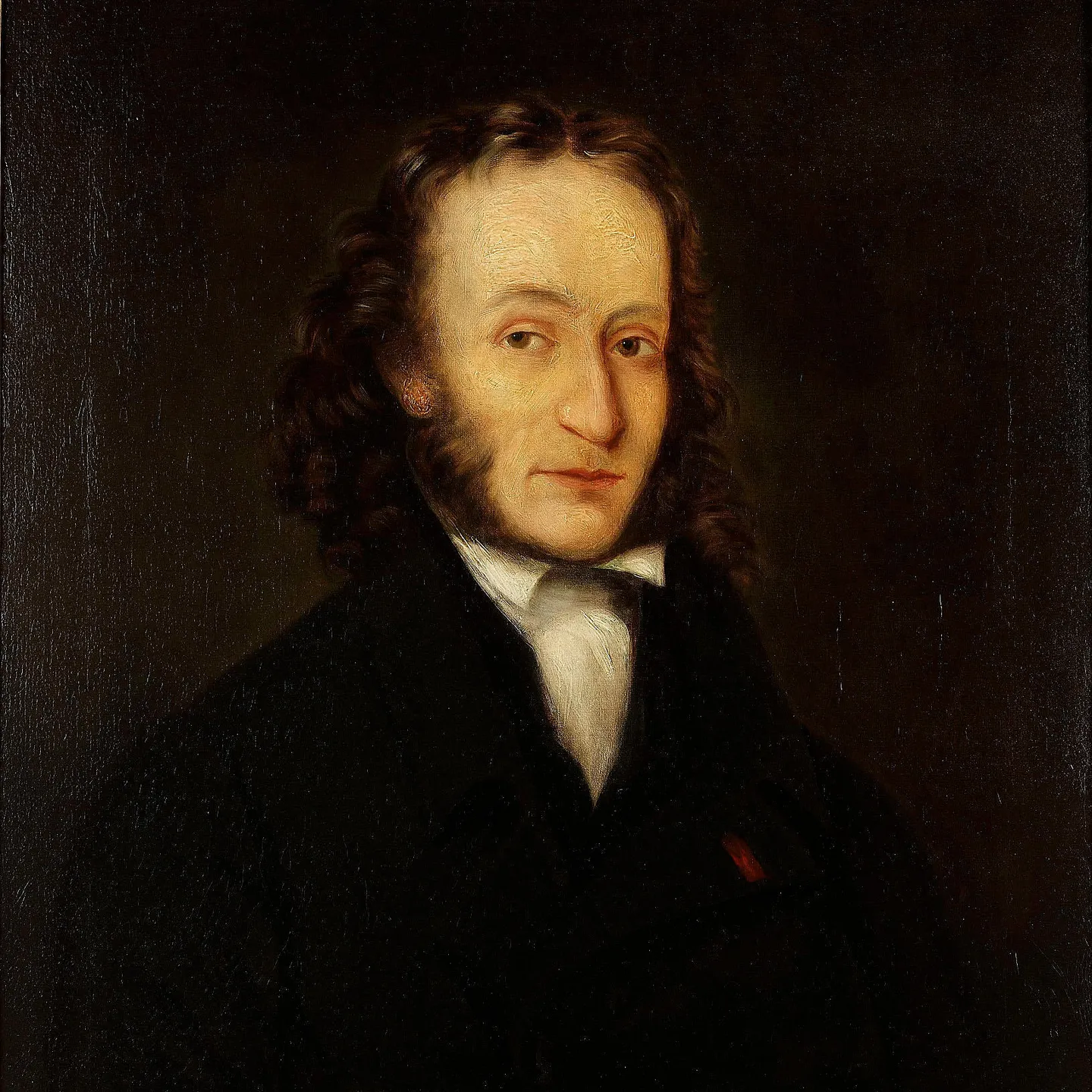
Biography
Niccolò Paganini was born on 27 October 1782 in Genoa, the third of six children of an unsuccessful ship chandler who supplemented his income playing the mandolin. Antonio Paganini recognised his son's gift early and exploited it ruthlessly, starting him on the mandolin at five, the violin at seven, and imposing a practice regime that could reach twelve or fifteen hours a day, with food withheld when the boy slacked. The discipline worked. By eight Paganini was composing; by eleven he was giving his first public concert at the San Filippo Oratorio in Genoa. He exhausted a succession of local teachers before travelling to Parma in 1796, where Alessandro Rolla, after hearing him play, declared he had nothing left to teach him and passed him on to the composers Ferdinando Paer and Gasparo Ghiretti for lessons in counterpoint and composition.
Independence and the Lucca Court
He gained his independence in 1801, when a trip to Lucca with his brother allowed him to slip free of his father. The years that followed were a period of conspicuous dissipation — gambling, drinking, women — during which the defining episode of his public image occurred: having pawned his own violin to cover a debt, he borrowed a 1743 Guarneri del Gesù from a wealthy merchant named Livron for a concert, and Livron was so overcome by the playing that he refused to take it back. The instrument, which Paganini named Il Cannone for its volume and resonance, remained his lifelong companion and now resides in Genoa. Between roughly 1801 and 1807 he composed the 24 Capricci per il violino solo, Op. 1, the work that would define him. In 1805 Lucca was ceded to Napoleon's sister Elisa Bonaparte Baciocchi, and Paganini entered her court orchestra as first violin, conducting an affair with Elisa herself before following her to Florence in 1807 and, by late 1809, resigning to return to the freelance life.
The Italian Years and the Devil Myth
His Italian reputation was built gradually through the 1810s, with his 1813 debut at La Scala in Milan marking the decisive breakthrough. The rumours circulating around him by this point were formidable: that he had been imprisoned for murder and learned his technique on a single-stringed violin in a dungeon, that his mother had sold his soul to the Devil, that Satan himself stood visible beside him on stage. Paganini did nothing to discourage any of this. He dressed in black, entered the stage with a stooped, skeletal gait, and performed entire pieces on a single string after theatrically breaking the other three. A brief 1815 imprisonment in Parma over an affair with the twenty-year-old Angela Cavanna fed directly into the prison legend. He befriended Rossini in 1818, conducted the Rome premiere of Matilde di Shabran in 1821 after the original conductor's sudden death, and in 1825 had a son, Achille, with the singer Antonia Bianchi. The relationship ended in 1828, and Paganini kept Achille, to whom he was devoted for the rest of his life.
The European Tour
He was forty-five when he finally left Italy for his European tour, and the delay had allowed every rumour to ripen. His Vienna debut on 29 March 1828 provoked hysteria; hats, hairstyles, and pastries were named for him. Goethe heard him at Weimar and described the experience as unfathomable. In Paris in March 1831, the young Franz Liszt attended a concert and emerged with the resolution to do for the piano what this man had done for the violin — a resolution that would reshape the nineteenth-century keyboard tradition from Liszt through Busoni to Horowitz. His London debut followed in June, a Scottish tour in 1832 brought him sixty-five concerts in thirty cities in three months, and by the time he settled in Paris in 1833 he was one of the wealthiest musicians in Europe. It was there that he commissioned Hector Berlioz to write him a viola concerto; Berlioz produced the symphony Harold en Italie, which Paganini judged insufficiently demanding and never played. But after finally hearing it performed in December 1838, Paganini sent Berlioz a gift of twenty thousand francs — a gesture that saved the composer from financial ruin and revealed a generosity rarely glimpsed beneath the theatrical persona.
Decline, Death, and the Unburied Corpse
The body that had sustained the great tour began failing in 1834. Modern scholarship attributes much of Paganini's freakish facility — the hyperextension of his joints, the span of his hand, the mobility of his thumb — to a connective-tissue disorder, most likely Marfan syndrome, the same condition that would eventually produce the aortic complications behind his progressive laryngeal paralysis. Syphilis contracted around 1822 and its mercury-based treatments had caused further damage, and tuberculosis compounded matters. A 1835 engagement reorganising the court orchestra of Marie Louise of Austria in Parma collapsed in conflict, and the Casino Paganini in Paris, a concert hall and gambling house that opened in November 1837, failed almost immediately, consuming what remained of his fortune in lawsuits. From 1838 he was mute, communicating by writing, with Achille interpreting the movements of his lips for visitors. He died of internal haemorrhage in Nice on 27 May 1840, aged fifty-seven, after refusing — or being unable to accept — the last rites from the parish priest who had been sent to administer them. What followed was one of the strangest posthumous journeys in European music. The Church denied him Catholic burial. His embalmed body was kept in a cellar in Nice, moved to Genoa in 1844 but still not interred, and finally, after thirty-six years of petitioning by Achille, buried in 1876 in the Villetta Cemetery in Parma, where it was reinterred in a new monument in 1896.
Legacy
Paganini's direct influence on violin playing is incalculable. Every significant violinist since has had to come to terms with the Caprices, and the techniques he developed or systematised — left-hand pizzicato, harmonics and double harmonics, ricochet bowing, extended scordatura — passed into the standard vocabulary of the instrument within a generation of his death. His less often remarked but arguably larger legacy reaches beyond the violin. Schumann wrote piano transcriptions of six of the Caprices; Brahms composed two books of punishing variations on the Caprice No. 24; Rachmaninoff's Rhapsody on a Theme of Paganini is among the most performed orchestral works of the twentieth century; Lutosławski used the same theme in 1941, and Andrew Lloyd Webber in 1977. The figure of the Romantic virtuoso — the performer as solitary genius, as mystery, as commercial brand, as personality distinct from and in some sense larger than the music — is essentially Paganini's invention. He was a sickly man who spent his last years unable to speak, whose body wandered for thirty-six years in search of a grave. What survives is neither the Devil nor the victim but the playing, preserved in the notation of the Caprices and the concertos, and in the voice of the instrument he named the Cannon, still speaking, in Genoa, once a month.