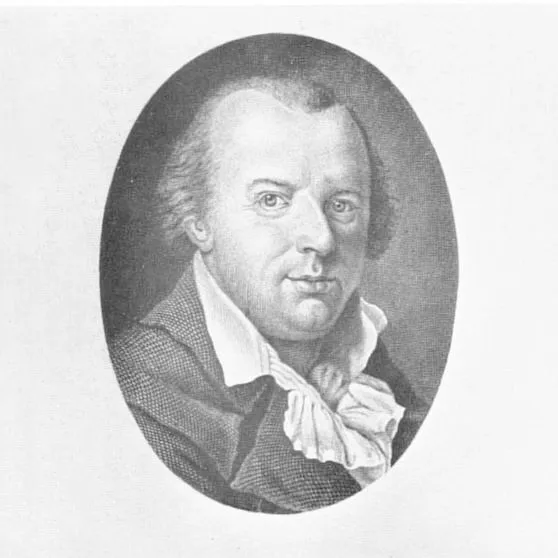
Biography
Johann Friedrich Reichardt was the greatest song-composer of his day, as well as a prolific journalist and gifted writer. His Vetraute Briefe aus Paris (1804) is widely regarded as one of the finest books ever written by a composer. At the age of twenty-three, in 1775, he was appointed Hofkapellmeister to the Prussian court in Potsdam, a prestigious position he held for fifteen years. His tenure ended abruptly when his radical political views led to his dismissal.
Undeterred, Reichardt relocated to Halle, where his home in nearby Giebichenstein became a vibrant meeting place for leading musicians and poets, including Tieck, Novalis, Brentano, and Arnim. He began setting the poetry of Johann Wolfgang von Goethe as early as 1772 and in 1790 planned a six-volume collection entitled Musik zu Goethes Werken. In 1789 he visited Goethe, bringing with him a musical setting of Claudine von Villa Bella—a text later set by Franz Schubert in 1815. Reichardt soon replaced Philipp Christoph Kayser as Goethe’s favored musical collaborator, and together they planned a large-scale opera based on a subject from Ossian.
Despite Goethe’s admiration for his music, Reichardt remained an independent and politically outspoken figure. Goethe could not approve of Reichardt’s sympathy for the French Revolution, and this ideological divide eventually caused a rupture in their relationship. Reichardt was satirized in the Goethe–Schiller Xenien (1797) as an ostrich—a half-bird incapable of flight, constantly in motion yet achieving little. Although contact was later resumed and Goethe visited Giebichenstein several times, by 1804 Carl Friedrich Zelter had become Goethe’s preferred musical adviser, and by 1810 the relationship with Reichardt had ended permanently.
Reichardt composed approximately 1,500 lieder, around 150 of them settings of Goethe. His remaining songs draw on an extraordinarily wide range of poets, including Schiller, Hölty, Claudius, and Klopstock. In both scope and quantity, the poetry he set far exceeds the output of Schubert or any other song-composer. His many song collections—bearing evocative titles such as Lieder der Liebe und der Einsamkeit—are notable for their exquisite production, with poetry and music printed side by side, though they are now prohibitively expensive for collectors. Regrettably, no complete modern edition of his songs exists beyond the Goethe settings.
Despite Goethe’s eventual preference for Zelter, Reichardt’s stature among composers remained high. Felix Mendelssohn, despite his close association with Zelter, was convinced that Reichardt was the greater song-composer. Mendelssohn maintained contact with Reichardt’s widow and appears to have valued Reichardt’s achievements in song even more highly than those of Schubert.