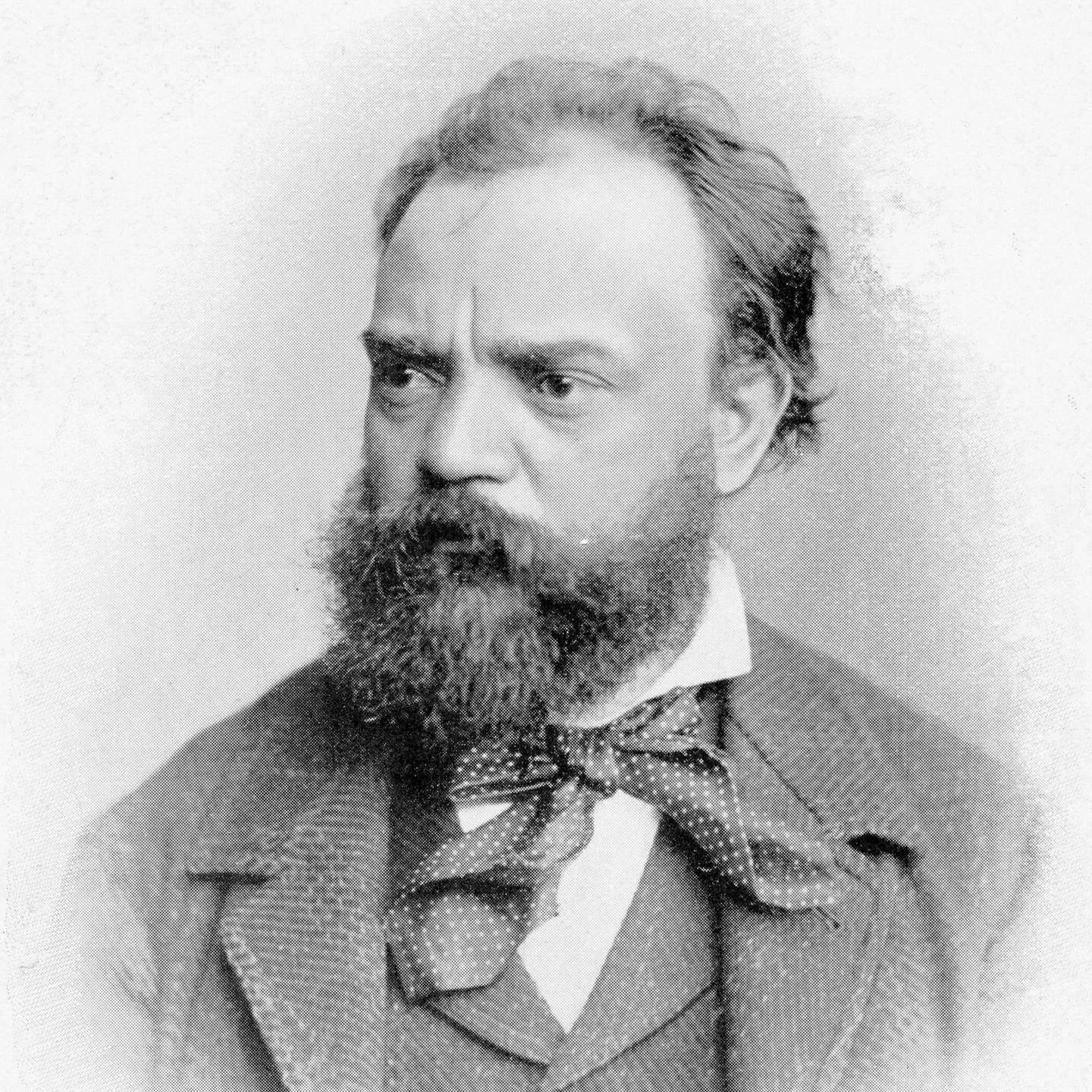
Biography
Antonín Dvořák was born on 8 September 1841 in Nelahozeves, a Bohemian village on the Vltava River north of Prague. His father ran a butcher shop and an inn, which in practice meant the family home doubled as a place where music was constantly happening — weddings, dances, local band rehearsals. Folk music accompanied every occasion, and Dvořák joined his father in the local band young. This wasn't an unusual childhood for rural Bohemia at the time, but it gave him something no conservatory could: an ear trained on music that actually meant something to the people playing it.
His father had plans for him that didn't involve concert halls. The expectation was that Dvořák would learn the butcher trade, take over the business, and stay in Nelahozeves. It didn't go that way. At 12, he went to live with relatives in Zlonice to study piano, organ, and other instruments. He showed enough talent that his teachers and his uncle pushed back against the family's commercial ambitions, eventually convincing his father to let the boy continue. By 1857, he was enrolled at the Institute for Church Music in Prague.
Prague in the late 1850s was a provincial capital of the Austrian Empire, Czech nationalism was simmering, and Dvořák arrived with very little money. He quickly showed an exceptional musical gift, leading to an early professional career mainly as a violist — first in a dance band, then in the orchestra of the Provisional Theater in Prague. It was a working musician's life, not a glamorous one. He played for dances. He took church organist jobs. He was also composing, largely in private, and it wasn't until the early 1870s that his music started to be performed, even in Prague.
Those early compositions weren't all keepers. The self-critical composer burned some of his early works. Some he simply abandoned. What remained from the 1860s included symphonies, string quartets, a song cycle, and a couple of operas — more output than most people realise from a composer whose public career hadn't started yet. In 1871, he resigned from the orchestra to concentrate on composing, scraping a living by teaching the piano.
Breakthrough
The real turning point came through Johannes Brahms, which is still one of the more remarkable strokes of luck in nineteenth-century music history. Dvořák had applied for the Austrian State Music Prize, a grant for struggling composers, and Brahms sat on the jury. He not only voted for Dvořák but took a personal interest in getting his music published. In 1877, on Brahms's recommendation, the publisher Simrock commissioned Dvořák to write Slavonic Dances for piano duet, aimed at the domestic market. In Berlin the sheet music sold out in one day.
That's a strange kind of overnight success — ten years of near-obscurity, then suddenly sold out in Berlin. The Slavonic Dances weren't just popular because of Brahms's endorsement. They were genuinely infectious, rooted in Czech, Slovak, and other Slavic folk idioms but dressed up with enough Romantic-era polish to work in bourgeois parlours. Dvořák had found a way to be both himself and commercially viable at the same time. It wouldn't always be that simple.
In 1884 he made the first of ten visits to England, where the success of his works — especially his choral pieces — was a source of constant pride. The English loved him in a way that was part genuine admiration and part exotic novelty, but Dvořák didn't seem to mind. In 1890, he enjoyed a personal triumph in Moscow, where two concerts were arranged by his friend Tchaikovsky. The following year he was made an honorary doctor of music at Cambridge. The Bohemian innkeeper's son who was supposed to become a butcher was now collecting honorary degrees from English universities. There's something satisfying about that trajectory.
America
Then came America, which is where the story gets genuinely strange.
In 1891, Dvořák received an offer from Jeanette Thurber, wife of a millionaire businessman, who wanted him as director of the National Conservatory of Music in New York. For a little teaching and conducting, with four months of vacation, he would receive the unimaginable salary of $15,000 — 25 times what he was paid in Prague. He accepted, sailed with his family in autumn 1892, and found himself dropped into Manhattan.
He did not love New York. He liked parts of it. He spent a quiet first year complaining frequently of poor health, preferring to pass his evenings at home playing darda, a Czech card game, with his assistant Josef Kovařík. Kovařík also accompanied him on his principal extracurricular activity: viewing the pigeons in Central Park. Dvořák was also an avid steamship and locomotive buff, and Kovařík often tagged along on jaunts to the docks of Lower Manhattan and the Harlem River railroad bridges.
The pigeon obsession deserves a moment. Back in Bohemia, Dvořák had filled his pigeon loft with as many different species as possible, corresponding frequently with his housekeeper while abroad to send detailed instructions on how to keep his birds healthy. Once or twice a week in New York, he would visit a small zoological garden in Central Park where about two hundred pigeons were kept. And when Dvořák's wife told Queen Victoria's representative that her husband's greatest love after music was his pigeons, the royal family sent him an unexpected gift: a shipment of prestigious English pigeon breeds. This is a man who received pigeon deliveries from Buckingham Palace. Somehow that detail doesn't appear in enough biographies.
Despite all this, his productivity in America was extraordinary. His time in New York produced three of his most famous works: the String Quartet No. 12 "American," the Cello Concerto in B minor, and the Ninth Symphony "From the New World." The New World Symphony premiered at Carnegie Hall in December 1893 under conductor Anton Seidl, and the New York Herald reported storms of applause from all sides and cries of "Dvořák!" from across the hall.
The symphony's relationship to American folk music is still debated. Dvořák said he had written "in the spirit of" American folk songs but had composed all the melodies himself. Many listeners point to the heavy use of the pentatonic scale as evidence of Native American influence, but he had used it before in his Slavic music. What he clearly absorbed was American geography and atmosphere, and perhaps an acute homesickness that gave everything a particular ache.
Spillville
The summer of 1893 offers the clearest picture of who he actually was. After a year in New York's hustle and bustle, city life had worn on him. He grew homesick. Kovařík suggested an alternative to sailing back to Bohemia: a visit to Spillville, Iowa, a prairie village of around 350 people, populated almost entirely by Czech immigrants. Dvořák, an enthusiastic railway fan, travelled there by express train. When he arrived, he immediately felt at home: "I played the organ in the little church often and with pleasure — the grannies were very happy to hear our beautiful Bohemian hymns again after so many years."
He quickly established a daily routine: wake early, walk in the woods, attend mass at St. Wenceslaus Church and play the organ during the service, then sit along the banks of the Turkey River listening to birds. A scarlet tanager caught his attention — he called it "some damned red bird, red, only with black wings" — and jotted down its insistent song, incorporating a variation into the string quartet he was composing.
The String Quartet in F major was completed by the end of June. Dvořák had first touched up the orchestrations of the New World Symphony, then composed the quartet, then another chamber work in July — the String Quintet in E-flat, whose second movement echoed a group of Algonquin Indians who had stopped at Spillville to sell herbal medicines and performed native dances practically at the Dvořáks' doorstep. All of this in under three months, in a town of 350 people in Iowa.
On the last page of the quartet sketches he wrote: "Thank God. I am pleased. It went quickly."
Later years and legacy
He returned to Bohemia in 1895 and didn't go back to America. He spent his last years at the Prague Conservatory, where he was granted an honorary position as teacher and later director. His output in these final years turned increasingly toward opera and tone poems — less internationally famous than his symphonies, but ambitious in a way that suggested he was still trying to work something out. Among the operas, Rusalka from 1900 remains the most performed, known above all for the aria "Song to the Moon."
He died aged 62 from a stroke on 1 May 1904, following five weeks of illness. He left behind many unfinished works.
The scale of what Dvořák produced is still a little staggering: nine symphonies, fourteen string quartets, multiple cello and violin concertos, oratorios, song cycles, tone poems, and a pile of operas. During the last years of his life, many throughout the Western world considered him the greatest of all living composers. His music still occupies a conspicuous position in the performance repertoire.
What's harder to convey is the particular quality of his musical personality — that combination of Bohemian folk directness and full Romantic orchestral ambition, somehow neither clashing nor fully resolving. He could write a melody so straightforward it sounds almost folk-derived, and then harmonise it in a way that makes you catch your breath. The New World Symphony's Largo, which eventually gave the world what Americans know as "Goin' Home," isn't technically a folk song at all; it just feels like one you've always known. That effect — the sensation of music that seems to have existed before the composer wrote it — is Dvořák's most distinctive trick, and he never quite explained how he did it.
What the record does show is a man who bred pigeons, rode trains for fun, got homesick in Manhattan, found more comfort in a Czech immigrant village in Iowa than in Carnegie Hall's ovations, and somehow managed, in between all that, to write some of the most affecting music of the nineteenth century.