In the liner notes for Lullabies from Soil and Sky, I wrote that after a week of recording and a week of editing, we did “a week of mixing and mastering in Baarn,” and then it was finally finished. I switched off the lights, laid down on the floor, and listened to the album from start to finish. I drifted off somewhere I’d never been before.
Every single word of that is true. It’s just not the whole truth.
The whole truth involves three months of mixing, over 280 tracks of audio for some songs, 3.2 terabytes of SSD storage, a monitor controller that forgot who it was, and my own brain. Mostly my brain.
This is by far (and I mean by far) the most complex production we’ve ever done here at TRPTK. So let me tell you how it really went.
Drawing circles
When Alisa Apreleva first came to us, there wasn’t an album yet. There was a list of beautiful lullabies from all over the world, and an idea. Before anyone pressed the big red record button, we first spent a long time in pre-production. Maya shaping the arrangements with Alisa, figuring out which instruments we would need, and who should play them. And drawing. A lot of drawing.
Every lullaby got its very own circle. A small dot in the middle for you, the listener, and around it every voice and instrument that would sing you to sleep. Just puzzling who should stand where took several days.
Then came the unglamorous part: guide tracks from Alisa, click tracks, patch lists, microphone lists, and one humongous diagram of every part we needed to record, when, and how. Many, many, many Excel sheets were born during this production. A huge thanks to my assistant engineer Wirre de Vries, who made sure every one of them turned into a setup that actually worked.
Turning eight musicians into a village
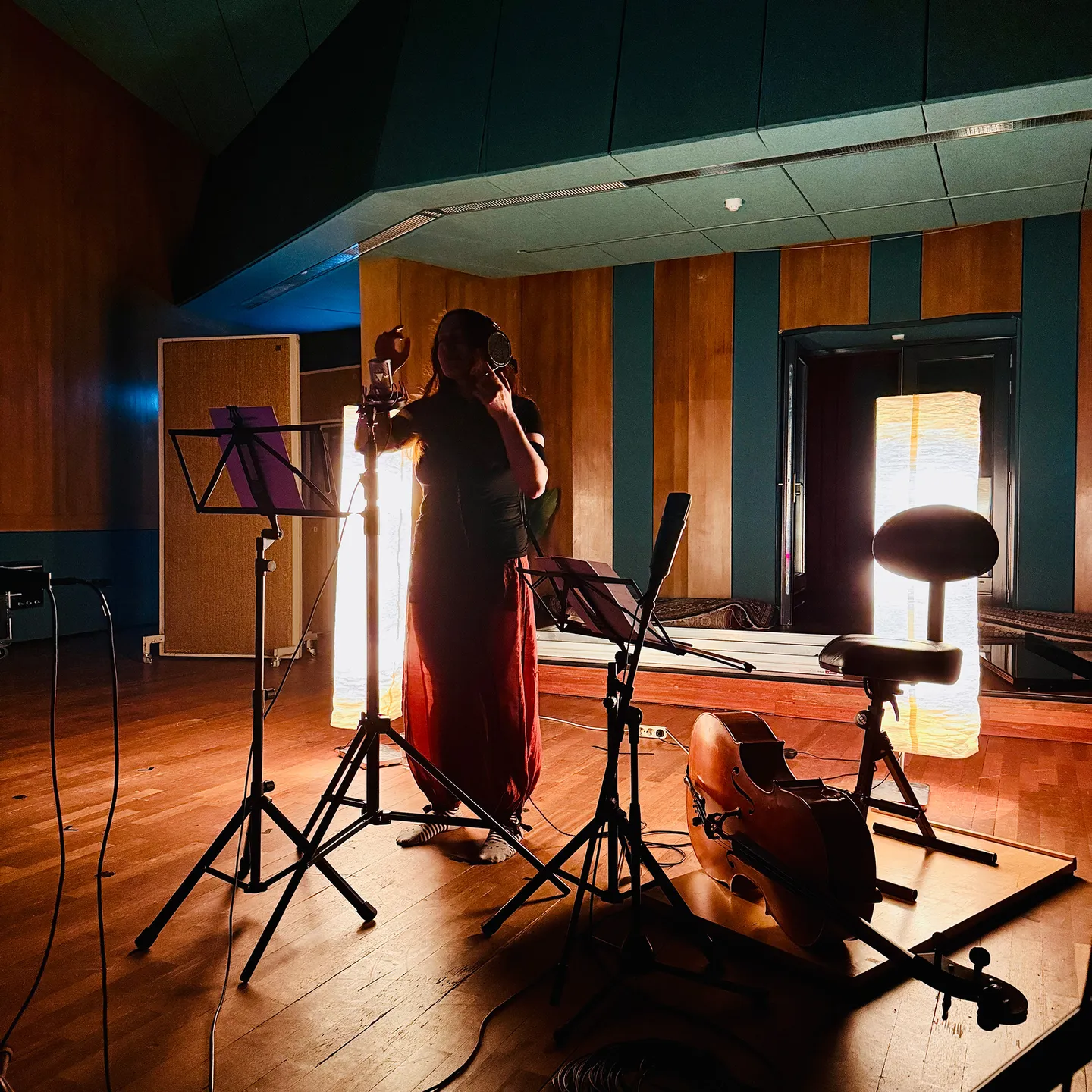
We recorded at Wisseloord Studios in Hilversum in June 2026. Eight days of twelve-hour sessions in Studio 1. Everything we recorded was done in 7.1.4-channel immersive at 352.8kHz 32bit, even the heartbeat you hear at the beginning and end of the album. (more technical details coming soon in an extensive behind-the-scenes blog, by the way)
Here’s the trick, though. The main mics never moved, not once throughout the entire week. Instead, we moved the musicians around it. Because the mics stay put, every spot in the room maps to a fixed spot around you as a listener. Put Maya and her cello to the left of the array, and she plays to your left. Move Haytham and his oud to the rear right of the array, and he’s behind you. Do this hundreds of times, and suddenly you have an ensemble that doesn’t really exist.
So Wirre, Lauran (my assistant producer) and I spent the entire week moving musicians, microphones, and headphones between takes, thinking about where to put them next, with the final mix (and our Excel sheets and drawings) in mind. We also kept an ever-growing list of every microphone, preamp gain, and mixer setting we had used, so the album would sound completely consistent from the first track to the last. Yes, yet another Excel sheet.
Most of the album was recorded one person at a time. Not for technical reasons, but simply because it was impossible to get eight busy musicians into one room on the same days. Everyone played on headphones, and we kept building new cue mixes so each musician felt like they were playing in an actual ensemble. The one lullaby we recorded with everyone in the room is the Greek one, with Alisa, Maya, and Haytham.
The recording itself went smoothly. Incredibly long days of hard work, but nothing went wrong. My favourite moment, though, was with Marion (von Tilzer, piano). Alisa had written out an entire piano part for her, and Marion played it absolutely beautifully. But it somehow didn’t touch me the way her playing always does. Marion and I have recorded plenty of albums together, so I know she’s a brilliant improviser, and I was worried that all those notes on the page made her feel too locked-in. So I asked for one final take: forget the score, play and pedal the way you want, and most of all: play what you feel instead of what you read. And boy, was it ever stunning. That’s the take you hear in the Turkish lullaby.
Done!
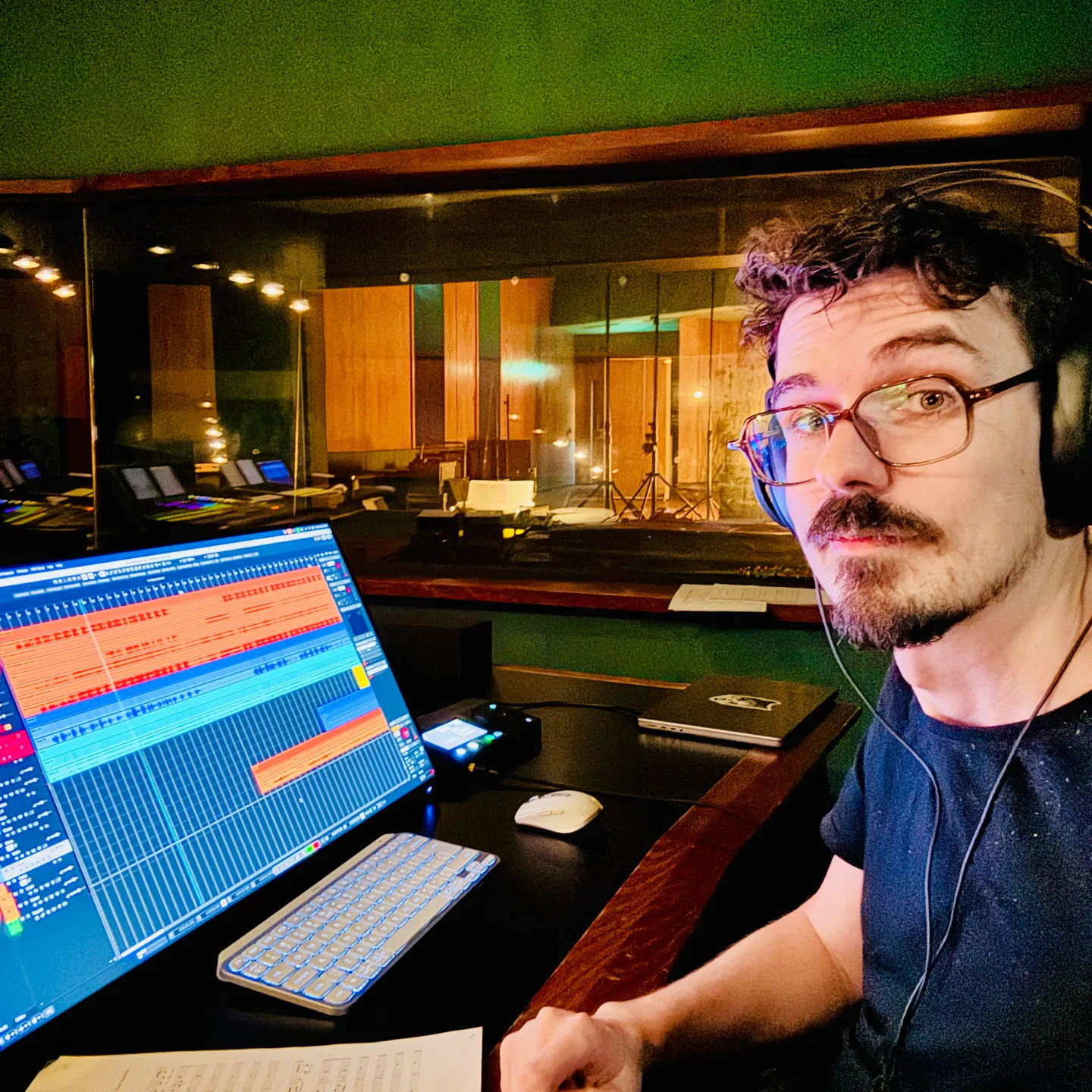
The first week of mixing happened with Alisa in the room with me in Baarn. I was already pretty exhausted from weeks of meticulous editing, and some edits still weren’t finished, so I did those at night after mixing all day.
By day seven we were nearly there. Alisa was leaving that afternoon. Around noon, we were listening back to a track and I glanced at my studio’s monitor controller. There I saw just about the worst thing I could’ve seen at that moment: the calibration hadn’t loaded. None of my speaker gains could be trusted, and the gains and delays on the height speakers were entirely off.
You might think: just turn the height channels up or done, done. Sadly, no. In our mixes, the main and height mics are always gained exactly the same, because that gives you the most natural balance. When something doesn’t sound spacious enough, you don’t just turn up the heights; you bring up the entire main array, heights included. So the only fix was to rebalance every close mic against every main mic yet again. In every song. All over again.
I have to be honest: I nearly broke down. I told Alisa, because I needed even more of her ears for this, and we got to work. From noon until evening, when Alisa left for Schiphol, and then by myself until little past midnight. I finished the mixes in my (calibrated!) studio, switched off the lights, laid down on the floor, and just drifted off.
That’s the moment in the liner notes. I wrote them right after.
But here’s the plot twist: it wasn’t finished.
Back to the mix
As with any project, the musicians came back with some minor comments on the edit. So, back to editing it was. And then back to mixing. Then a few more small comments. Back to mixing again.
Working with Alisa was truly special. I tend to think in technical terms. She approaches music not just in a musical way, but as an experience. Sometimes the audiophile way and the experiential way clashed, so we had to find a third solution. Those solutions were often the best ones.
Personal triggers
A couple of times a year, a project tends to trigger something in me. It happens when everything lines up: fantastic music, something new that still feels accessible, and a great recording. That feeling of “we’ve got gold in our hands, but we’re not quite there yet”. This album triggered that. Badly.
For two and a half months, I spent days at my studio, making the tiniest of changes to the mix: a fraction of a dB here, a different EQ there, and back again.
The hardest part was Alisa’s voice. For a TRPTK album, this is almost a pop album. For a pop album, though, it was almost classical. Somehow, the sound had to sit somewhere in between, and somehow, that’s incredibly difficult. We normally have hard and fast rules: no dynamics compression, no EQ unless it’s fixing a problem. This works for classical music. But for a pop album, EQ is a creative tool, and without any compression a voice can become flat and far away.
We actually ended up with a five-step approach, for the gear nerds. Alisa sang into a close mic and the main array. The main array only got a high-pass filter against room hum and to keep clarity in the mix. The close mic then got EQuilibrium (EQ) to tame the Ehrlund’s typical harshness up close, then Multiplicity (multiband compressor) to smooth out some resonances in the voice, then another EQuilibrium to get rid of some of the proximity effect, and then finally a TrackComp (compressor) with a very slow attack and release, doing just 1.5–2 dB of gain reduction. It took me four or five multi-day mixing sessions to get there.
And in the spirit of full disclosure: DMG Audio’s Dualism (M/S processor) was added to balance the soundstage of the piano. We used Limitless (multiband limiter) as our mastering limiter, which only touched two tracks on the album, shaving off some tiny peaks. We added space through our home-made impulse response of the 15th-century Westerkerk (Enkhuizen) through AltiVerb.
Yes, there’s compression on a TRPTK album. Come at me, audiophile forum people.
Done! Or so I thought
And there it was. Finally, it was done. Really done. So I sat down with Maya to listen through the masters I had just proudly made.
I love doing that with her, because she’s an even worse perfectionist than I am. She hears everything. She’s my biggest inspiration as a producer, and also my greatest critic, in the best possible way.
But the verdict came in, and it wasn’t a great one. She felt the musicians and the vocals weren’t blending enough. And you know what? She was absolutely right. In all those months of polishing, I had leaned so hard on making sure everything sounds beautiful, that I had neglected to make it sound beautiful together. And so, I spent another week tweaking the mix yet again. In a very different approach, and you can hear it.
I won’t pretend that Maya’s comments didn’t shake my confidence. It honestly did. But I’m so grateful she was there and said it so candidly. Only through criticism can we get better, is what I always say.
Why I’m telling you all this
I could’ve just kept the nice version from the liner notes. But as some of you may know, I’m an open book, and mental health stuff matters too much to keep quiet about.
This album is what happens when deep perfectionism, insecurity, and a truly obsessive eye for detail all go to work on the same project. I take my work extremely personally. Lots of producers do. So do lots of musicians, and frankly lots of people who have nothing to do with music.
It isn’t always healthy. But it’s also exactly why this album sounds the way it does. I’d love for this album to truly reach people’s hearts. And alright, I’ll say it out loud: I’d love for it to get a GRAMMY nomination or even consideration for Best Immersive Audio Album. There. It’s on the internet now.
Full circle
Lullabies from Soil and Sky comes out on 12 February, just in time for Valentine’s Day. If you can, listen the way I did that night in Baarn: lights off, lying down, nowhere to be. And don’t worry about it ending. The album is recorded as a circle, so as Into the Dream Realm fades out, the waves carry you right back to In Utero.
Which, as you now know, is also exactly how it was mixed. Round and round we go.