Description
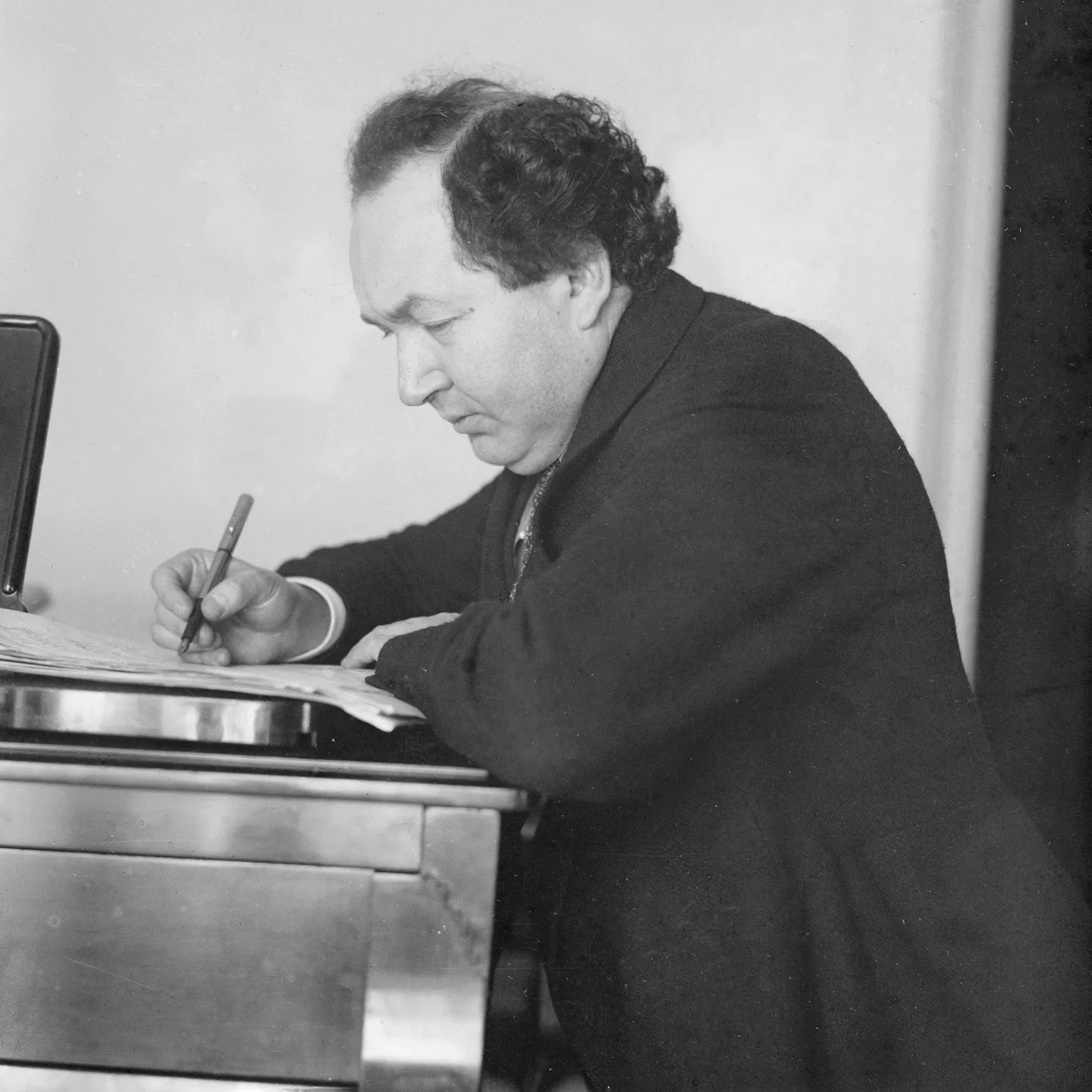
Leopold Godowsky visited Java during a journey through the Far East that began in Japan on 13 October 1922 and ended in Honolulu on 25 May 1923 — a trip that took the pianist-composer to Hong Kong, Shanghai, Beijing, Singapore, Java, and the Philippines.
Japan and China only half won him over; too crowded, too many people. It was not until Java, which he also found slightly too busy with its forty million inhabitants, that he truly fell under Asia's spell. Everything about the island enchanted him: the royal cities of Solo (Surakarta) and Djokja (Yogyakarta), the kratons, the markets, the rice paddies, the volcanoes, the sunrise from the rim of the Bromo crater, the five hundred Buddha statues at Borobudur, the wayang puppet theatre, the oldest district of Batavia — Kota Tua — and the gardens of Buitenzorg. But what truly overwhelmed him was encountering an exceptionally refined culture that derived its expressive power from an instrument that, like the piano, is a percussion instrument: the gamelan.
On Java, Leopold Godowsky did not compose a single note, but the gamelan music lingered in his ears for weeks, months, years, and ultimately resulted in his most beautiful work — the Java Suite, fifty minutes of music that can be listened to as a kind of travel diary.
Gamelan is a collective term for a variety of percussion instruments, from metallophones and xylophones to gongs and drums — 'gamelan' is derived from the Javanese gamel: to strike. Godowsky was not the first composer to be captivated by the distinctive sound of a gamelan orchestra, a simultaneously soft and penetrating bronze resonance whose deepest and darkest tone is the gong. Claude Debussy had already fallen under the spell of Javanese sounds at the 1889 World Exhibition in Paris. He visited the Dutch East Indies pavilion several times, where a complete Javanese village had been reconstructed and a gamelan orchestra played continuously, filling the air with mysterious sounds. Gamelan motifs kept running through his head, and he used them in 'Pagodes', the first of his Estampes from 1903. Debussy set a precedent: Maurice Ravel let the echo of the gamelan be heard in 1905 in Jeu d'eau — one of his most beautiful compositions and, despite its Javanese influence, entirely Ravel — and in the last of his Miroirs: 'La vallée des cloches'. Béla Bartók referenced the gamelan directly in Mikrokosmos Vol. IV No. 109 by giving the piece the title 'From the Island of Bali', composing it for two pianos around 1930. Another fine example is the first movement of Francis Poulenc's Concerto for Two Pianos from 1932, a stunning piece of music in which the inimitable Poulenc combines gamelan influences with Mozart.
Godowsky, too, sought in his Java Suite to blend Eastern sounds with a Western framework of scales and octaves. The fourteen pieces for piano open with 'Gamelan' to establish the mood immediately — a mood that is both mysterious and precise. Incidentally, John George Hinderer, who had been Godowsky's personal secretary for many years, wrote in a commentary in The Musician that Godowsky had been fascinated by the gamelan at the World Exhibition, just as Debussy had been. In 1889 and 1890 the young Leopold Godowsky was indeed in Paris; he may well have visited the Indies pavilion together with Saint-Saëns, for Saint-Saëns too considered the gamelan 'an Eastern sensation' and could scarcely be dragged away from the Dutch East Indies pavilion.
In Solo, Godowsky listened for hours on end, with deep concentration, to the percussion instruments. Nothing conveyed the mysterious and strange character of the island and its people so powerfully, he wrote in his introduction to the score of the Java Suite. 'The sonority of the gamelan is so peculiar, spectral, fantastic and enchanting, the indigenous music so elusive, hazy, glittering and singular, that while listening to this new world of sound I lost my sense of reality and imagined myself in an enchanted realm.'
The way he rendered that world of sound on the piano was nothing short of astonishing. He combined the piano technique of Chopin and Liszt with the striking technique of the Javanese gamelan masters in a wholly natural way — giving form not only to the symbiotic encounter between two continents, but also between different eras. The gamelan is far older than the piano, the fortepiano, or the harpsichord. Between the 8th and 11th centuries it already graced the court life of Hindu and Buddhist kingdoms across Java, Bali, and Sumatra. With the Java Suite, Godowsky also embarks on a breathtaking journey through time.
This is all the more remarkable given that he spent only six weeks on Java, from mid-February to the end of March 1923 — during which he also gave twenty recitals: full-length programmes consisting mainly of works by Chopin and Liszt. On this tour, too, a piano tuner accompanied him, which was not without reason: in addition to the two grand pianos he brought on every journey, he had arranged for four more concert grands to be made available, so that the performances could meet his own exacting standards. Cost: 25,000 US dollars. Godowsky was perpetually travelling or preparing for his next performance, and yet he still found time to visit every cultural landmark, to make contact with Javanese musicians and composers, and — above all — to immerse himself in the essence of the gamelan.
(…)
Godowsky, born in 1870 in Vilnius, Lithuania, wrote 'Gamelan' in Berlin, 'Borobudur in Moonlight' in New York, 'In the Streets of Old Batavia' in Evanston, Illinois, and 'The Gardens of Buitenzorg' in Chicago. Not one of the fourteen pieces in the Java Suite was composed on Java. He provided the score with an introduction, gave precise indications for pedalling to make the piano sound as much like a gamelan as possible, and published the complete work in May 1925 through music publisher Carl Fischer in New York.
To put the performer in the right frame of mind, he accompanied each piece with a brief characterisation. For 'The Gardens of Buitenzorg' he wrote: 'The intensely fragrant air awakens an unutterable deep and poignant longing for unknown worlds, unattainable ideals, events of the past that have irrevocably vanished, memories that the ocean of time gradually submerges and ultimately buries in oblivion. Why do certain aromas evoke inexpressible regret, insatiable desires, undefinable longings?'
I recognise what Godowsky touches on — 'events of the past that have irrevocably vanished', 'memories that the ocean of time gradually submerges' — though I wonder how much use it is to a pianist. Perhaps the intensely fragrant air had gone somewhat to Godowsky's head.
He emphasises in his accompanying text that he has written pp — pianissimo, 'very softly' — with remarkable frequency in the score, to prevent the Java Suite from being performed as a bravura showpiece. Like all of Godowsky's works it is virtuosic, but above all he wants it to sound as a musical travel impression: a particular mood that carries the listener along and intoxicates them.
Preceding 'The Gardens of Buitenzorg', Godowsky included three dances in the Java Suite. The first was intended to express 'the languor and melancholy of the Far East', the second 'the grace and charm of the Eastern dancers', the third 'their poetry and tenderness'. Those explanatory notes are a little predictable, but fortunately you don't hear that in the music.
In the first piece, 'Gamelan', he searches for the extremes achievable on a percussion instrument and lets the music arrive in waves, just as a gamelan orchestra does. It is truly a tour de force how he achieves this on the piano; within three minutes the boundaries dissolve and you find yourself at the heart of Java. In the second, 'Wayang Purwa', he captures precisely the jerky movements of the wayang puppets. In the third and fourth pieces, 'Hari Besaar' and 'Quarrelling Monkeys at the Sacred Wendit Lake' — both busy and lively — he develops the gamelan rhythms further. Things become truly mysterious in the fifth piece, 'Borobudur in Moonlight'.
Borobudur was, at the time of Godowsky's visit, far more of a ruin than when Olga (my mother) clambered up the terraces of the temple complex twelve years later, but the composer saw the stupas — the bell-shaped shrines that house the relics of Buddhist saints — by moonlight, and this inspired him to write mysterious sounds, as though someone is very softly tapping the inside of the bells and they resonate with a deep, dark ring.
Godowsky regarded the Java Suite as the beginning of a series of musical works to be inspired by his travels. He had devised a Latin term for them: 'Phonoramas' — or, in other words, panoramas for the ear. The full title of the Java Suite is accordingly 'Phonoramas' – Tonal Journeys for the Pianoforte – Java Suite. After Java, a Russian suite was to follow, then a Spanish, a Moroccan, a Turkish, and a Jewish suite — 'rather like Liszt's Hungarian Rhapsodies', he wrote to a friend. The influence of Liszt is unmistakable, though more that of the Années de Pèlerinage (Years of Pilgrimage).
The journey as a source of musical inspiration was one of the ideals of European high Romanticism, beginning with Schubert's Winterreise. For the Romantics, travel was a form of mental purification with a powerfully cleansing effect on body and spirit; if all went well, one returned from a journey reborn. A journey to the Far East amplified these effects and was considered a plunge into a mystical and spiritual world. One might call Godowsky a forerunner of George Harrison — the most adventurous of the Beatles — who sought his salvation in India and found his model in sitar virtuoso Ravi Shankar.
I also hear an echo of Saint-Saëns in the Java Suite, particularly of the Fifth Piano Concerto, nicknamed 'The Egyptian'. A curious concerto from 1896, full of Oriental and sensual longing, whose middle movement was inspired by a Nubian song Saint-Saëns had heard boatmen singing on the Nile. The other movements of that Fifth Piano Concerto are a medley of impressions gathered by the insatiably travelling composer — Algerian, Indian, Sri Lankan, Indochinese, Japanese. The young Godowsky clearly absorbed more from Saint-Saëns than he was willing to acknowledge as an adult — or perhaps it is better to say that Saint-Saëns made him receptive to exotic musical influences. Saint-Saëns, too, saw travel as a form of mental cleansing and as a way of processing grief.
After completing his Java Suite, Godowsky considered doing something further with the impressions he had gathered in Japan and China, but it was never to be. While recording Chopin's Nocturnes in 1930, he suffered a stroke that left him almost entirely paralysed on his right side, largely extinguished his memory, and brought his career as a pianist and composer to an end. He could no longer perform or make gramophone recordings. Just once he made an exception, allowing a recording to be made at his home of 'The Gardens of Buitenzorg'.
Eight years later, Godowsky died — on 21 November 1938, at the age of sixty-eight, in New York. By then he had already become a distant memory. In the obituaries, journalists were preoccupied with just one question: whether he had ever been able to collect the one million dollars for which he had insured his hands in the 1920s. An exorbitant sum, they thought, even then.
Liner notes by Jan Brokken