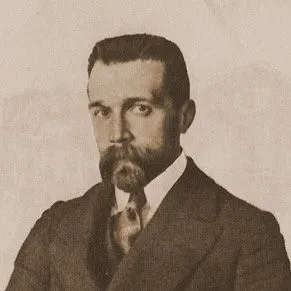
Biography
Nikolai Myaskovsky (1881–1950) was a Russian composer and pedagogue, widely regarded as the “father of the Soviet symphony.” Born in the Russian Empire, he initially pursued a military career before turning fully to music, studying composition at the Moscow Conservatory under Sergei Taneyev.
Myaskovsky’s output is dominated by his 27 symphonies, which chart a distinctive personal and artistic evolution from late-Romantic expressiveness to a more restrained, introspective modernism shaped by the upheavals of the early 20th century and Soviet cultural policy. His music is known for its emotional gravity, long-breathed melodic lines, and complex harmonic language, often conveying a sense of introspection rather than overt virtuosity.
In addition to his compositional work, Myaskovsky was a highly influential teacher at the Moscow Conservatory, mentoring a generation of Soviet composers, including Aram Khachaturian and Dmitri Kabalevsky. Despite periods of official criticism—most notably during the 1948 Zhdanov decrees—he remained a respected figure in Soviet musical life. Today, Myaskovsky is increasingly appreciated for the depth, integrity, and emotional honesty of his symphonic and chamber works.