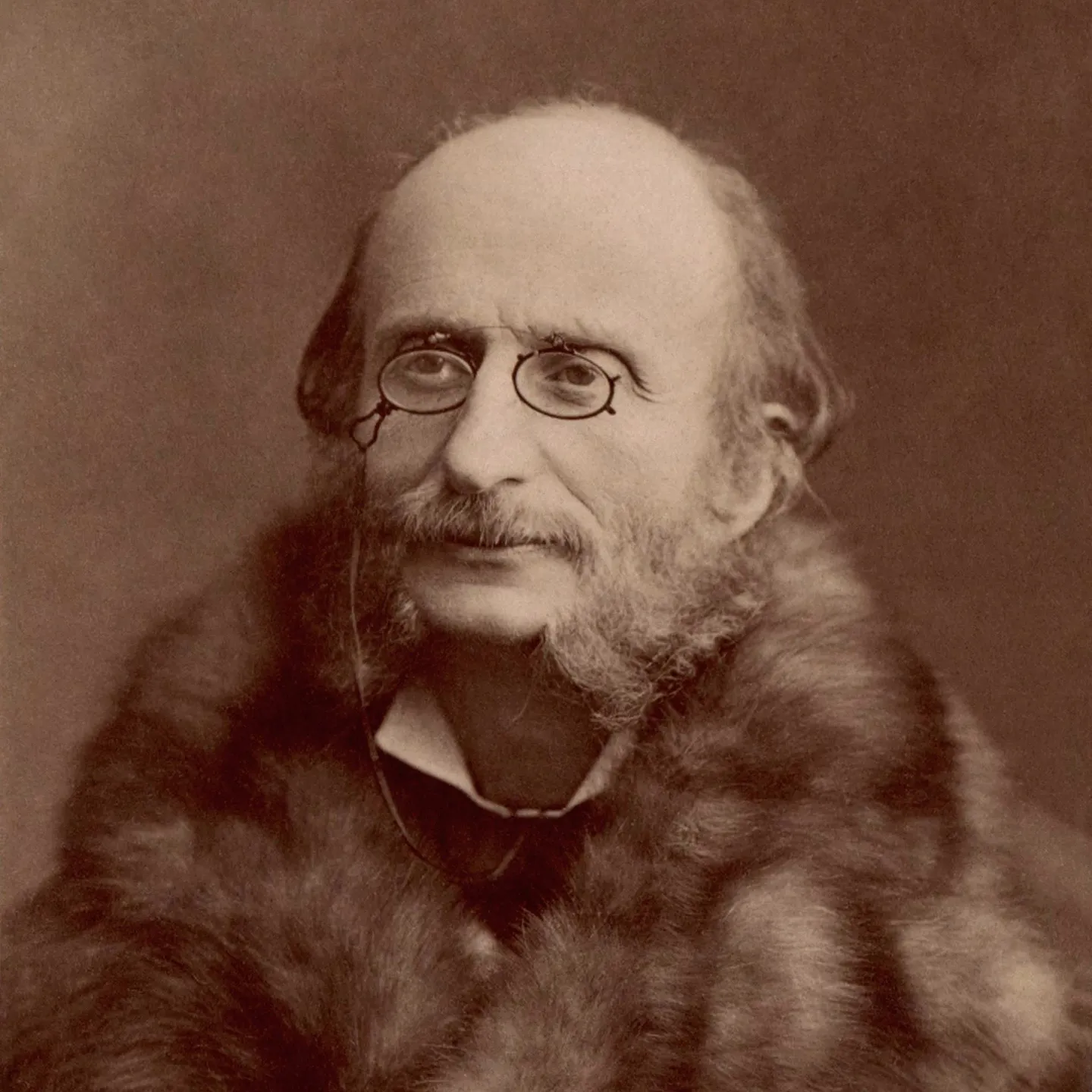
Biography
Jacques Offenbach was born Jacob Eberst in 1819 before his father, a Cologne synagogue cantor, changed the family name to Offenbach. Despite having German-Jewish origins, Offenbach has come to be considered a French composer because of his great regard for Paris.
Although admitted to the Paris Conservatory, Offenbach left and found employment as a cellist at the Opera-Comique. This was followed by a successful early career as a virtuoso on the cello, for which he wrote a number of works, including a Concerto Militaire.
Offenbach was the main founder of operetta—light opera with dialogue. He continued a successful career largely devoted to it and operas comiques. In 1855, he opened his own theatre, Les Bouffes-Parisiens, where he produced one-act plays. Limited in scope by lack of space, he moved to a larger theatre where, in 1858, he presented the shockingly satirical Orpheus in the Underworld.
He subsequently produced a constant stream of lively, witty, and melodious operettas that became the vogue of the major capitals of the world. Much of his music is uniquely comic, and many of his numbers are composed in the style of the lively can-can dance with which the world associates him. But there is a touch of wistful melancholy running through even the most lively of his works.
In 1876, he visited the United States for the U.S. Centennial Exhibition. While there, he conducted two of his comic operas, La Vie Parisienne and La Jolie Parfumeuse. Offenbach brought the same deft touch and gift for melody to his more serious opera, The Tales of Hoffmann, which is regarded by many as his greatest work. Based on the strange tales of the German writer E.T.A. Hoffman, the opera contains some of Offenbach’s loveliest melodies.
Offenbach died in Paris on October 5, 1880. In 1881, The Tales of Hoffmann premiered posthumously.