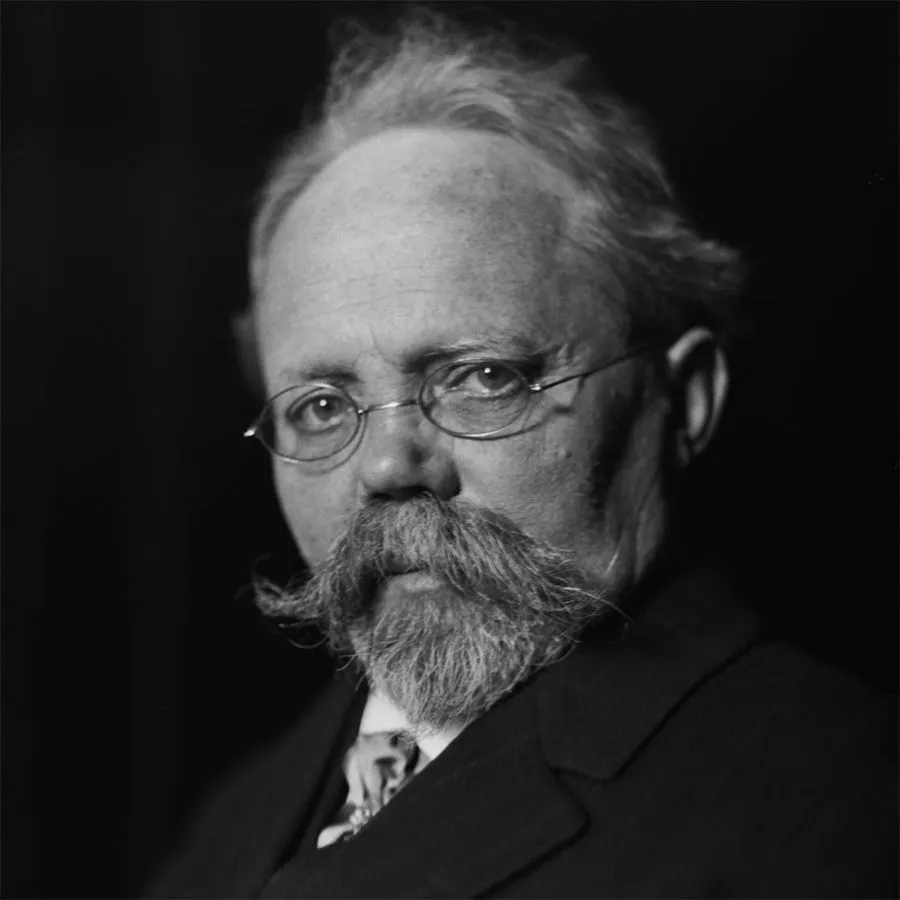
Biography
Engelbert Humperdinck was born at Siegburg in the Rhine Province in 1854. After receiving piano lessons, he produced his first composition at the age of seven. His first attempts at works for the stage were two singspiele written when he was thirteen. His parents disapproved of his plans for a career in music and encouraged him to study architecture.
But he began taking music classes under Ferdinand Hiller and Isidor Seiss at the Cologne Conservatory in 1872. In 1876, he won a scholarship that enabled him to go to Munich, where he studied with Franz Lachner and later with Josef Rheinberger. In 1879, he won the first Mendelssohn Award given by the Mendelssohn Stiftung (foundation) in Berlin.
He went to Italy, where he became acquainted with composer Richard Wagner in Naples. Wagner invited him to join him in Bayreuth; and during 1880 and 1881, Humperdinck assisted in the production of Parsifal. He also served as music tutor to Wagner’s son, Siegfried.
After winning another prize, Humperdinck traveled through Italy, France, and Spain. For two years, he taught at the Gran Teatre del Liceu Conservatory in Barcelona. In 1887, he returned to Cologne. He was appointed professor at the Hoch Conservatory in Frankfurt in 1890 and also teacher of harmony at Julius Stockhausen’s Vocal School. By this time, he had composed several works for chorus and a Humoreske for small orchestra, which enjoyed a vogue in Germany.
Humperdinck’s reputation rests chiefly on his opera Hänsel und Gretel, on which he began work in Frankfurt in 1890. He first composed four songs to accompany a puppet show his nieces were giving at home. Then, using a libretto and thematic suggestions by his sister Adelheid Wette that were rather loosely based on the version of the fairy tale by the Grimm Brothers, he composed a singspiel of 16 songs with piano accompaniment and connecting dialogue. By January 1891, he had begun working on a complete orchestration.
The opera premiered in Weimar on December 23, 1893, conducted by Richard Strauss. With its highly original synthesis of Wagnerian techniques and traditional German folk songs, Hänsel und Gretel was an instant and overwhelming success.
Hänsel und Gretel has always been Humperdinck’s most popular work. In 1923, the Royal Opera House (London) chose it for their first complete radio opera broadcast. Eight years later, it was the first opera transmitted live from the Metropolitan Opera in New York.
In 1896, Kaiser Wilhelm II made Humperdinck a Professor and he went to live at Boppard. Four years later, he went to Berlin, where he was appointed head of a Meister-Schule of composition. His students included Basque composer Andrés Isasi, Portuguese composer Luís de Freitas Branco and Kurt Weill.