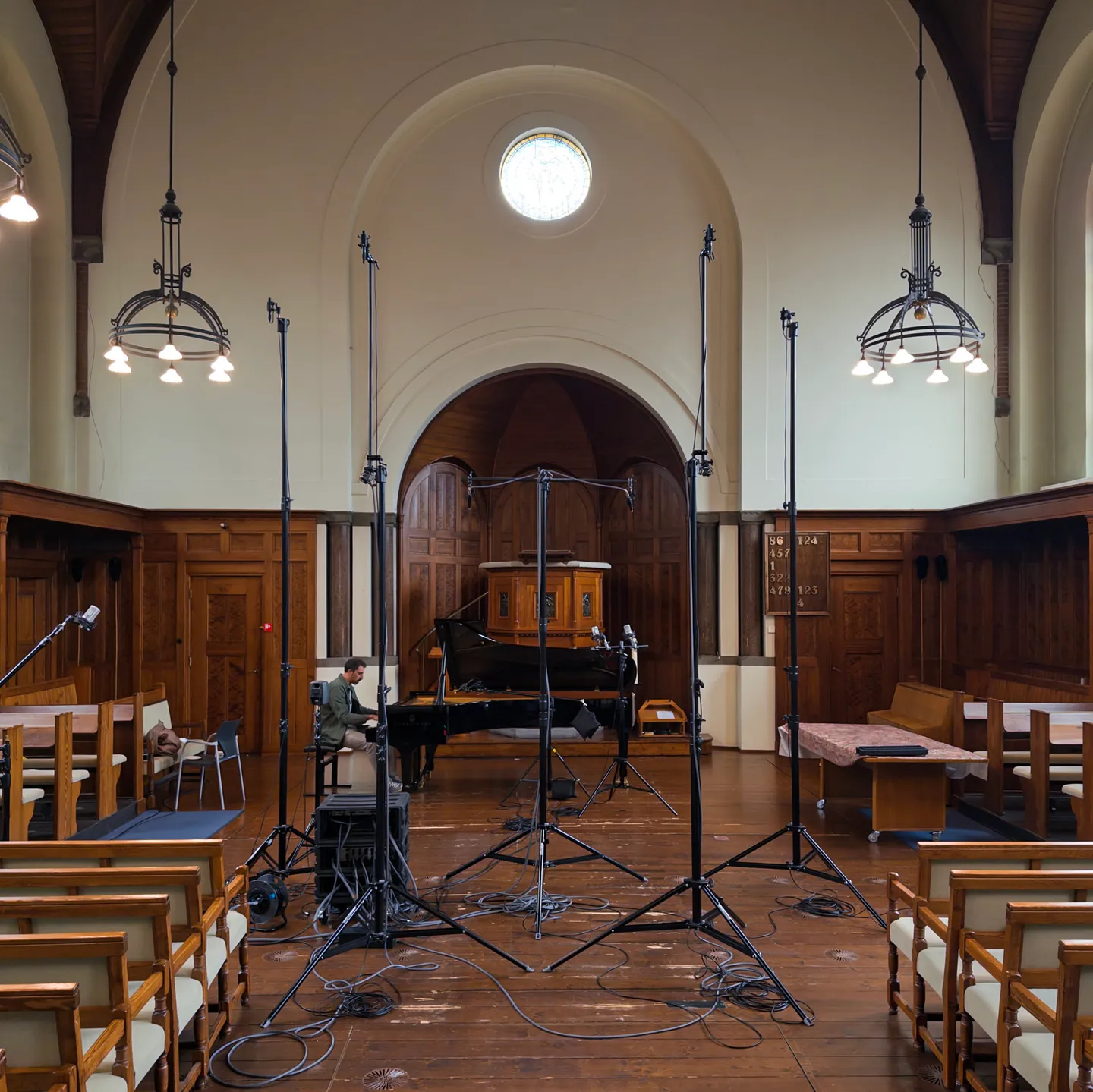
Last september, we wrapped up an album recording at Westvest90, a beautiful church in Schiedam with an equally beautiful Steinway Model D concert grand. We were way ahead of schedule, so suddenly we had the church, the piano, and a full day still booked, but nothing left to record.
Rather than let this all go to waste, I called up pianist, composer, and dear friend Avishai Darash with what was essentially a non-plan: just drop by, have some coffee, maybe play some improvisations or something he had lying around, and see what happened. To his credit, he actually said yes without hesitation...
A session without a plan
That very morning I had genuinely no idea whatsoever, what to do with the time, the space, or the instrument for that matter. But once Avishai was on board, I suddenly had a recording session to prepare for in what was basically a matter of an hour. So I just winged it.
I started by putting our main microphone array (the TRPTK Optimized Omnidirectional Array, OOA for short) consisting of five Josephson C617 mics with Microtech Gefell MK221 capsules, somewhere I thought they could work. I added the four height mics for the Dolby Atmos, DTS:X and Auro-3D mixes, and then on a whim, I added a small-ish spaced pair of two omni mics a bit closer to the piano. This is not something we normally do at TRPTK; in 95% of cases we use just the main array and nothing else, and in the other 5% we add cardioids (more unidirectional microphones) as close mics. This time, though, I grabbed a pair of the same Josephson C617s with the Gefell capsules that I had as my main system. I always keep two spare ones as backups, but this time I thought, why not try these?
No soundchecks
We ran our usual test recording to check whether the sound made any sense at all. Normally this kicks off a bit of a back-and-forth between listening, tweaking the mics, record some more, and rinse and repeat. This time, I listened back and got confused.
It just worked.
The close pair of omni mics sat relatively low in the mix; we make a habit of never having close mics go over 6 dB below our main array, so I started out at around -10 dB. But somehow, in combination with where and how our main array got put, something just clicked into place. Might've been the positioning, might've been the room. Or it might've been the fact that, every single microphone in the session was from the same matched set, with an identical frequency response, an identical phase response, identical gain, etc. Whatever the reason was, the result was that I somehow stumbled into the most coherent, natural piano sound I've ever captured.
Why the piano is so hard to get right
And the reason I'm telling you this long story, is because the piano is such a notoriously difficult instrument to record truthfully. Its sonic and spatial palette is extraordinarily complex; the way it radiates differently across the registers, the interplay between the direct sound of the mechanics and the body of the instrument, the way it sort of couples itself with the space it sits in... Getting anywhere close to something that feels real is genuinely hard. Most piano recordings, maybe even your favourite ones, involve some level of compromise. Some trade-off between detail and warmth, between presence and spaciousness.
And yet, somehow this one didn't. At least for me. Or at least, for the first time, I couldn't hear where the compsomise was.
Now, will I be able to reproduce this exact sound later? I have no idea; I know the setup, I know the mics very well, and I know the room and piano pretty well. But there's something pretty nifty about the fact that my best piano recording came from a session I didn't plan out, a mic setup I didn't overthink, and a decision I made because I just happened to have my backup mics with me. I guess, sometimes, not preparing really is the best technique...
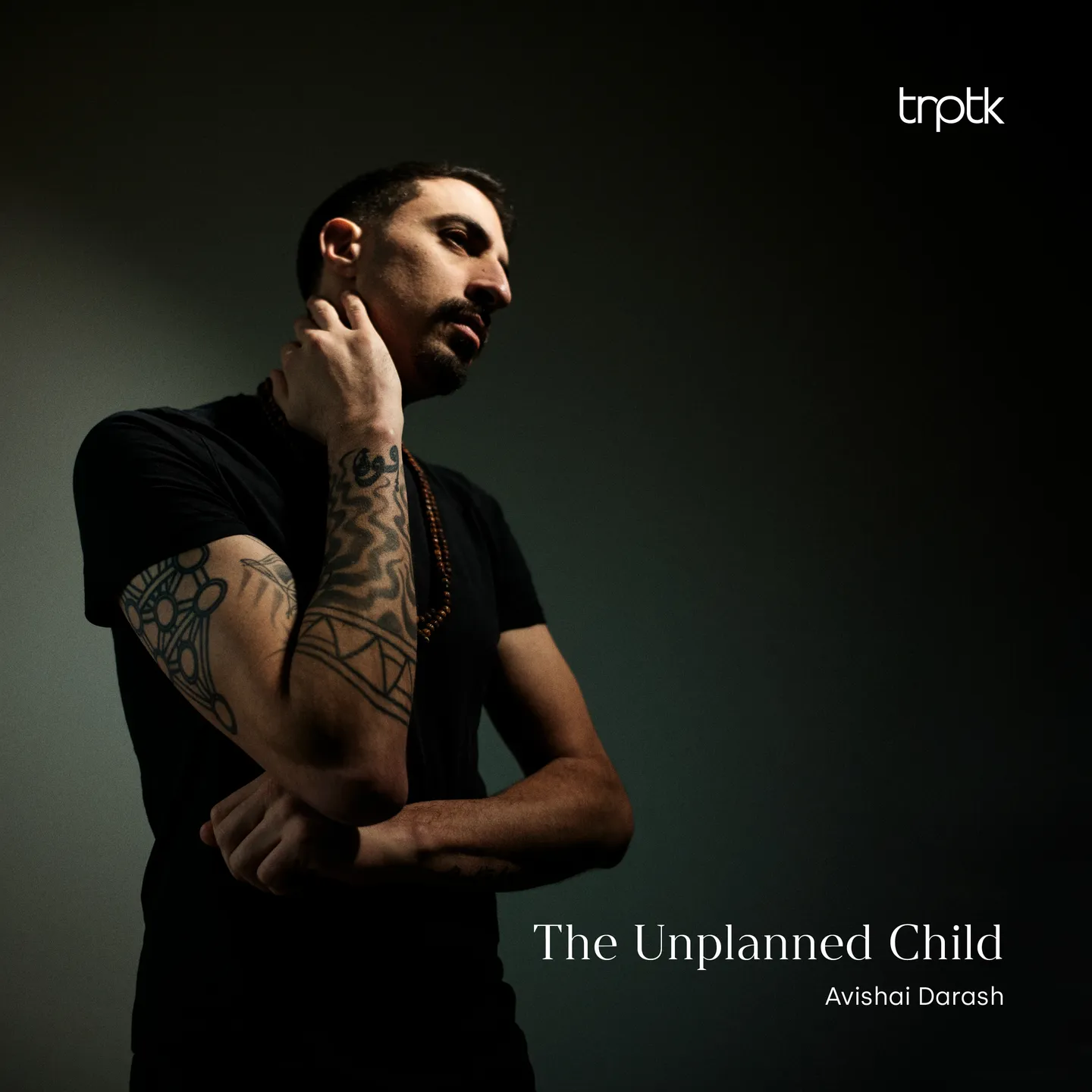
Thank you so much for reading these thoughts. The end result of this sound can be listened to on The Unplanned Child (EP) by Avishai Darash. Be sure to pre-order this, and stay around for more news!